 An official website of the United States government


Iowa
Grantee Details
Fiscal Year:
2026
Annual Funding:
$2,094,970
Website:
https://fpcouncil.org/
Program Summary
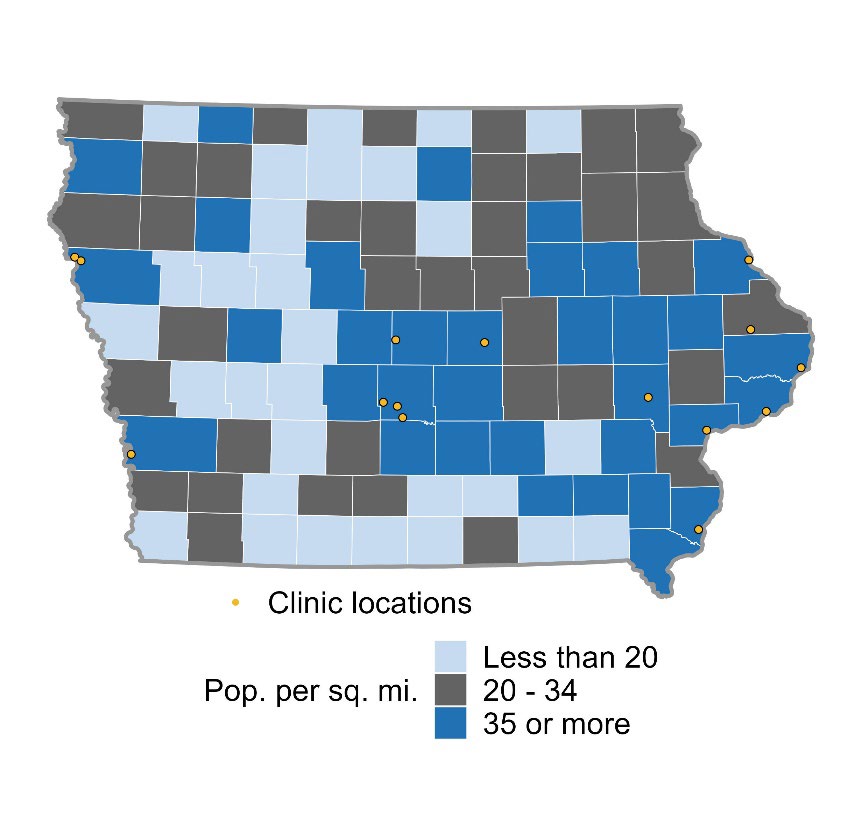
Family Planning Council of Iowa (FPCI) is a private, nonprofit organization that has been a statewide Title X grant recipient for more than 40 years. FPCI delivers services to approximately 15,000 clients a year through subrecipients, which are free-standing family planning clinics, federally qualified health centers (FQHCs), Planned Parenthood clinics, public health departments, and hospital-based clinics.1
Stats at a Glance2
- Number of family planning (FP) encounters – 30,121
- FP users with incomes below 100% Federal Poverty Level (FPL) – 7,207 (47%); all FP users with incomes below 250% of FPL – 11,823 (77%)
- Number of tests performed for gonorrhea – 11,467, syphilis – 4,877, and HIV – 5,434
- Number of female users who received a chlamydia test – 7,148 or a Pap test – 2,307
Overview of Services Offered
As a Title X recipient, FPCI provides a broad range of FP services including pregnancy prevention and birth spacing, pregnancy testing and counseling, assistance to achieve pregnancy, basic infertility services, sexually transmitted infection (STI) services, and other preconception health services. The services are voluntary, confidential, and provided regardless of ability to pay.3 The list below is an Overview of Services Offered within the FPCI network. The data shown below are not specific to any particular site but rather are representative of the broader grantee network. For information on services available at individual service sites, please refer to the OPA clinic locator.
* Available through referral only.
- Counseling on achieving pregnancy
- Preconception health services
- Pregnancy testing and counseling
- Basic infertility services
- FDA approved long-acting contraceptives
- FDA approved short-acting contraceptives
- Natural family planning methods
- STI and HIV education and counseling
- STI and HIV screening and testing
- STI and HIV treatment
- STI self-testing*
- Expedited partner therapy
- PrEP counseling and risk assessment
- PrEP prescription services
- PEP counseling
- PEP prescription services
- Screening for breast cancer
- Screening for cervical cancer
- HPV vaccinations
- Screening for intimate partner violence
- Screening for mental health
- Screening for obesity
- Screening for smoking, drug, and alcohol use
- Adolescent-friendly health services
Footnotes
1 Source: Data collected by Mathematica in 2023 for the Title X Implementation Study.
2 Source: Family Planning Annual Report (FPAR): 2022 National Summary.
3 See the Title X Service Grants web page for more information on the requirements and regulations guiding Title X projects.